
What is VO₂max?
The Complete Guide to Maximum Oxygen Uptake, Fitness, Performance, Heart Health, and Longevity
Imagine two runners standing side by side at the starting line of a marathon.
Both trained for six months.
Both follow healthy nutrition.
Both sleep well.
Both wear the latest running shoes.
Yet one runner finishes comfortably while the other struggles halfway through the race.
Why?
Most people believe the answer is stronger muscles, greater determination, or simply “better fitness.”
In reality, one physiological measurement often explains the difference.
That measurement is VO₂max.
Whether you’re an elite athlete preparing for competition, a recreational runner training for your first 10K, a cyclist aiming to improve performance, or simply someone who wants to live a longer and healthier life, understanding your VO₂max can completely change the way you approach exercise.
Over the past decade, VO₂max has become one of the most important measurements in sports science. However, its importance extends far beyond athletic performance.
Scientific research consistently demonstrates that VO₂max is one of the strongest predictors of cardiovascular health, physical fitness, healthy aging, and even life expectancy.
Simply put, the better your body can use oxygen, the better it can perform—and the healthier it is likely to be.
Unfortunately, many people have never measured their VO₂max. Others rely solely on smartwatch estimates, which can differ considerably from laboratory measurements.
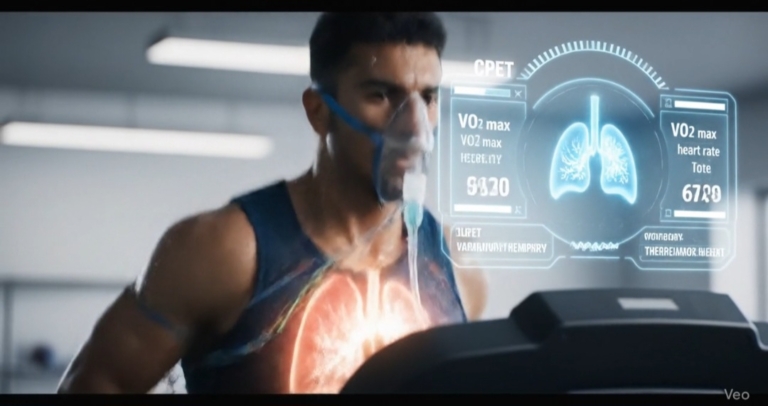
The most accurate way to measure VO₂max is through Cardiopulmonary Exercise Testing (CPET)—the gold standard assessment of how your heart, lungs, circulation, and muscles work together during exercise.
Instead of guessing how fit you are, CPET provides an objective and scientifically accurate measurement of your body’s aerobic capacity.
In this comprehensive guide, you will discover:
What VO₂max actually means.
Why it is important for athletes and non-athletes alike.
How VO₂max influences sports performance and everyday health.
Why VO₂max is considered one of the strongest predictors of longevity.
How CPET accurately measures VO₂max.
Practical, evidence-based strategies to improve your VO₂max safely and effectively.
By the end of this article, you’ll understand why many sports cardiologists and exercise physiologists consider VO₂max to be one of the most valuable measurements of human fitness and overall health.
What Does VO₂max Mean?
Imagine trying to drive a high-performance sports car with only half a tank of fuel reaching the engine. No matter how powerful the engine is, the car can never perform at its full potential because it simply isn’t receiving enough fuel.
Your body works in a remarkably similar way.
Every movement you make—whether you’re climbing stairs, running a marathon, cycling, swimming, or even walking briskly—depends on one essential ingredient: oxygen.
Your muscles use oxygen to produce the energy needed for movement. The more oxygen your body can deliver and utilize efficiently, the more energy it can generate, allowing you to exercise harder, longer, and with less fatigue.
This ability is measured by a single physiological parameter known as VO₂max.
The term VO₂max can be broken down into three simple components:
V = Volume
O₂ = Oxygen
Max = Maximum
Together, VO₂max represents the maximum amount of oxygen your body can take in, transport, and use during intense exercise.
In scientific terms, VO₂max reflects the integrated performance of your lungs, heart, blood circulation, and skeletal muscles. It is not simply a measure of lung function or cardiovascular fitness—it represents how efficiently the entire oxygen transport system works together.
For this reason, many exercise physiologists consider VO₂max to be the gold-standard measure of aerobic fitness and cardiorespiratory capacity.
The higher your VO₂max, the greater your body’s ability to produce energy through aerobic metabolism, enabling sustained physical performance with less reliance on early fatigue.
Why Is Oxygen So Important?
Every second, billions of cells in your body require energy to survive.
This energy is produced primarily inside tiny structures called mitochondria, often referred to as the powerhouses of the cell.
Inside the mitochondria, oxygen combines with nutrients such as carbohydrates and fats to produce adenosine triphosphate (ATP), the body’s energy currency.
When oxygen delivery is efficient:
Your muscles contract more efficiently.
You fatigue later.
Recovery is faster.
Exercise feels easier.
Athletic performance improves.
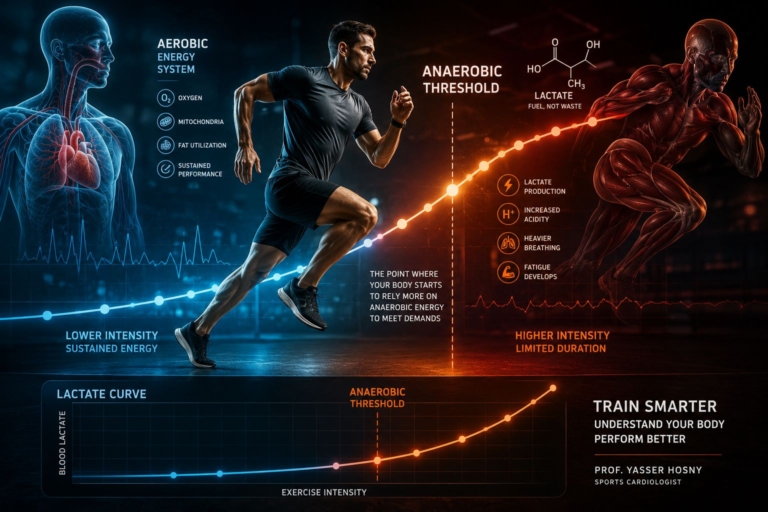
When oxygen delivery becomes insufficient, your body increasingly relies on anaerobic metabolism. While this pathway can produce energy quickly, it is far less efficient and leads to the accumulation of metabolites associated with fatigue, forcing you to slow down.
In simple words, VO₂max tells us how large your body’s “aerobic engine” really is.
Think of VO₂max as Your Body’s Engine Size
One of the easiest ways to understand VO₂max is to compare the human body to a car.
Imagine two cars driving up the same steep mountain road.
One has a small engine.
The other has a powerful engine.
Both drivers press the accelerator equally hard.
The smaller engine quickly reaches its limit, struggles to maintain speed, and consumes more fuel.
The larger engine climbs comfortably with less effort because it has a greater capacity to generate power.
Your cardiovascular system behaves in much the same way.
A person with a higher VO₂max has a larger aerobic “engine.” Their heart pumps more blood, their muscles extract oxygen more efficiently, and their mitochondria produce energy more effectively.
As a result, activities that feel exhausting for one person may feel relatively easy for another.
This is why two athletes who appear equally fit can perform very differently during endurance events.
The athlete with the higher VO₂max generally has a greater capacity to sustain high-intensity exercise before fatigue develops.
However, VO₂max is not reserved for elite athletes.
For everyday individuals, a higher VO₂max often means:
Climbing stairs without becoming breathless.
Playing with children or grandchildren more comfortably.
Walking longer distances.
Maintaining independence with aging.
Lower risk of cardiovascular disease.
Better overall quality of life.
In other words, VO₂max is not just about winning races—it is about preserving health and function throughout life.
Why Is VO₂max Important?
If there is one number that summarizes your body’s ability to perform physical activity, it is VO₂max.
Although VO₂max is often associated with elite athletes and Olympic champions, its importance extends far beyond sports. Whether your goal is to complete a marathon, climb stairs without becoming breathless, maintain independence as you age, or reduce your risk of cardiovascular disease, VO₂max provides valuable insight into your overall health and physical fitness.
Unlike body weight or body mass index (BMI), VO₂max measures how well your body functions, not simply how it looks.
It reflects the combined performance of your lungs, heart, blood vessels, blood, and muscles. Because all of these systems must work together to deliver oxygen efficiently, VO₂max has become one of the most comprehensive indicators of cardiorespiratory fitness.
For this reason, many experts consider VO₂max to be the body’s “vital sign of fitness.”
Why Does VO₂max Matter for Athletes?
For athletes, VO₂max represents the size of the aerobic engine.
A higher VO₂max generally allows athletes to:
Sustain higher exercise intensities for longer periods.
Recover faster between training sessions.
Delay fatigue during endurance events.
Improve race performance.
Train more effectively using individualized heart rate zones.
However, VO₂max alone does not determine success.
Elite performance also depends on factors such as:
Exercise economy
Lactate threshold
Anaerobic threshold
Mental preparation
Technical skills
Nutrition
Recovery
Nevertheless, VO₂max remains the foundation upon which endurance performance is built.
Why Does VO₂max Matter Even If You Are Not an Athlete?
One of the biggest misconceptions is that VO₂max only matters to runners, cyclists, or professional athletes.
Nothing could be further from the truth.
Imagine two people in their sixties walking up the same flight of stairs.
One reaches the top comfortably while talking.
The other becomes breathless after only a few steps.
The difference is often not age itself—it is aerobic fitness.
A higher VO₂max means your daily activities require a smaller percentage of your maximum capacity.
As a result, everyday tasks become easier, including:
Walking
Carrying groceries
Playing with your children or grandchildren
Gardening
Climbing stairs
Travelling
Remaining independent later in life
This is one reason why maintaining a good VO₂max is closely linked to healthy aging.
VO₂max and Longevity: Is the Strongest Predictor of a Longer Life.
Perhaps the most surprising fact about VO₂max is that it predicts much more than athletic performance.
Large scientific studies have consistently shown that people with higher cardiorespiratory fitness generally have:
Lower rates of cardiovascular disease.
Lower all-cause mortality.
Better metabolic health.
Reduced risk of type 2 diabetes.
Better cognitive function with aging.
Lower risk of functional disability.
In fact, several studies suggest that low cardiorespiratory fitness may be a stronger predictor of premature death than many traditional cardiovascular risk factors.
Think of VO₂max as a report card for your body’s most important systems.
A high VO₂max usually indicates that your heart pumps blood efficiently, your lungs deliver oxygen effectively, your muscles use oxygen well, and your mitochondria produce energy efficiently.
These are the same physiological characteristics associated with healthy aging.
This is why improving VO₂max is no longer viewed solely as a way to enhance sports performance—it is increasingly recognized as an investment in long-term health.
A Real-Life Example
Imagine two 45-year-old men.
Both have similar body weight.
Both have normal blood pressure.
Neither smokes.
One has a VO₂max of 55 mL/kg/min.
The other has a VO₂max of 28 mL/kg/min.
On the outside, they may appear equally healthy.
On the inside, however, their cardiovascular reserve is dramatically different.
The individual with the higher VO₂max generally has greater physiological capacity to cope with physical stress, illness, and aging.
In many ways, VO₂max represents how much “reserve capacity” your body possesses.
That reserve becomes increasingly valuable as we grow older.
How Is VO₂max Measured?
Although VO₂max is widely discussed in sports science and fitness, many people are surprised to learn that it cannot be measured simply by looking at someone’s appearance, body weight, or athletic ability. Two individuals with similar body composition may have very different VO₂max values because their hearts, lungs, circulation, and muscles do not function in exactly the same way.
For this reason, an accurate assessment requires specialized testing.
Today, several methods are available to estimate or measure VO₂max. However, they differ considerably in terms of accuracy.
1-Smartwatches and Fitness Trackers
Many modern smartwatches estimate VO₂max using information such as:
Heart rate
Running speed or cycling power
Age
Sex
Body weight
Activity history
These estimates can provide a general indication of aerobic fitness and are useful for tracking trends over time.
However, it is important to understand that they do not directly measure oxygen consumption.
Instead, they rely on mathematical algorithms, which may become less accurate in individuals with cardiovascular disease, highly trained athletes, those taking medications that affect heart rate, or when exercise conditions vary.
Smartwatch estimates should therefore be considered screening tools rather than diagnostic measurements.
2. Exercise Testing Without Gas Analysis
Traditional treadmill or bicycle exercise tests can evaluate:
Exercise duration
Heart rate response
Blood pressure response
Electrocardiogram (ECG)
Symptoms during exercise
Although these tests provide valuable cardiovascular information, they cannot directly measure VO₂max because they do not analyze the gases you breathe.
At best, they estimate aerobic capacity using prediction equations, which are inherently less accurate than direct measurement.
Cardiopulmonary Exercise Testing (CPET): The Gold Standard
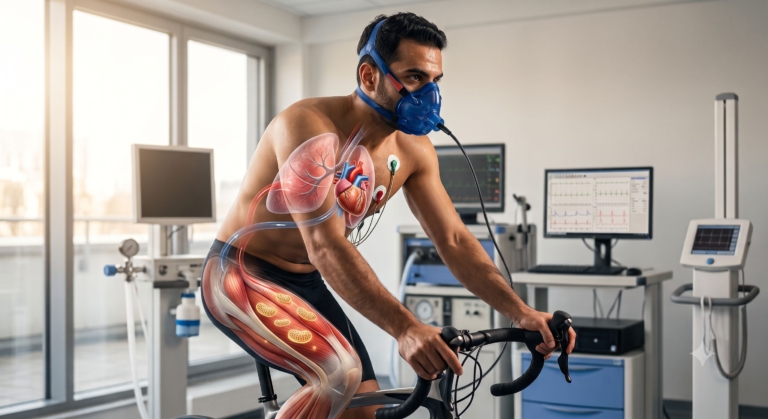
The Cardiopulmonary Exercise Test (CPET) is internationally recognized as the gold standard for measuring VO₂max.
Unlike conventional exercise tests, CPET analyzes every breath you take while exercising.
During the test, you wear a comfortable face mask connected to a highly specialized metabolic analysis system.
As exercise intensity gradually increases, the equipment continuously measures:
Oxygen consumption (VO₂)
Carbon dioxide production (VCO₂)
Minute ventilation (VE)
Breathing pattern
Respiratory rate
Heart rate
Blood pressure
Electrocardiogram (ECG)
Exercise capacity
These measurements provide a comprehensive picture of how your heart, lungs, circulation, and muscles work together during exercise.
Rather than estimating your fitness, CPET measures it objectively and precisely.
Why Is CPET So Accurate?
Imagine trying to determine how much fuel a car uses simply by watching it drive.
You might make a reasonable estimate.
Now imagine connecting sophisticated sensors directly to the engine, measuring fuel consumption, air intake, exhaust gases, engine efficiency, and power output in real time.
The second approach provides a far more accurate assessment.
CPET works in much the same way.
Instead of estimating oxygen consumption, it directly analyzes every breath you inhale and exhale throughout the exercise test.
This breath-by-breath analysis allows physicians to determine:
Your true VO₂max
Your ventilatory thresholds
Your anaerobic threshold
Your respiratory compensation point
Your maximal heart rate
Fat oxidation
Carbohydrate utilization
Exercise limitations
No smartwatch or prediction equation can provide this level of physiological detail.
Why Measuring VO₂max Matters More Than Guessing?
Many people believe they know their fitness level because they exercise regularly.
Unfortunately, appearances can be misleading.
Two runners training together may run the same distance every day, yet have significantly different VO₂max values and very different physiological responses to exercise.
Without measuring VO₂max, training intensity is often based on assumptions rather than objective data.
By accurately measuring VO₂max, exercise programs can be individualized according to each person’s physiology, allowing training to become more effective, safer, and scientifically guided.
This is one of the greatest advantages of CPET.
It transforms exercise prescription from educated guessing into precision medicine.
What Is a Normal VO₂max? Understanding Reference Values by Age and Sex
| Age (years) | Men (mL/kg/min) | Women (mL/kg/min) |
| ———– | ————–: | —————-: |
| 20–29 | **47.6 ± 11.3** | **37.6 ± 10.2** |
| 30–39 | **43.0 ± 9.9** | **30.9 ± 8.0** |
| 40–49 | **38.8 ± 9.6** | **27.9 ± 7.7** |
| 50–59 | **33.8 ± 9.1** | **24.2 ± 6.1** |
| 60–69 | **29.4 ± 7.9** | **20.7 ± 5.0** |
| 70–79 | **25.8 ± 7.1** | **18.3 ± 3.6** |
These are mean reference values from directly measured treadmill CPET tests in the FRIEND Registry.
Reference: Kaminsky LA, Arena R, Myers J, et al. Reference Standards for Cardiorespiratory Fitness Measured With Cardiopulmonary Exercise Testing: Data From the Fitness Registry and the Importance of Exercise National Database (FRIEND). Mayo Clinic Proceedings. 2015.
These values represent population averages, not “ideal” targets.
Athletes often have values well above these means.
VO₂max should always be interpreted in the context of age, sex, training status, body composition, symptoms, and clinical history.
The most meaningful comparison is often your own progress over time using repeat CPET measurements, rather than comparing yourself with someone else.
What Factors Influence VO₂max?
One of the most common questions people ask is:
“Why does my VO₂max differ from someone else’s?”
The answer is that VO₂max is influenced by several physiological, genetic, and lifestyle factors. While some of these cannot be changed, many can be improved through appropriate training and healthy habits.
Understanding these factors helps explain why two people of the same age and body weight may have very different aerobic capacities.
1. Genetics
Genetics plays an important role in determining your natural aerobic capacity.
Some individuals are born with larger hearts, higher stroke volumes, greater lung capacity, or muscles that utilize oxygen more efficiently.
Studies suggest that genetics may account for approximately 20–50% of an individual’s VO₂max.
However, genetics is not destiny.
Even people with average genetic potential can achieve substantial improvements through structured training.
2. Age
VO₂max generally reaches its highest values during early adulthood.
After approximately 30 years of age, it gradually declines by about 5–10% per decade in sedentary individuals.
Fortunately, regular exercise significantly slows this decline.
Many active adults maintain excellent aerobic fitness well into their 60s and 70s.
3. Sex
On average, men have higher VO₂max values than women.
This difference is mainly related to:
Larger heart size
Higher hemoglobin concentration
Greater muscle mass
Lower average body fat percentage
Importantly, VO₂max should always be interpreted using sex-specific reference values.
4. Training Status
This is the factor you can influence the most.
Regular aerobic exercise increases:
Stroke volume
Mitochondrial density
Capillary density
Blood volume
Oxygen extraction by muscles
Together, these adaptations improve oxygen delivery and utilization, leading to higher VO₂max values.
5. Body Composition
VO₂max is commonly expressed relative to body weight (mL/kg/min).
Excess body fat increases body weight without contributing to oxygen utilization during exercise.
Therefore, improving body composition through appropriate nutrition and exercise may increase relative VO₂max, even if absolute oxygen consumption remains unchanged.
6. Medical Conditions
Several health conditions can reduce VO₂max, including:
Coronary artery disease
Heart failure
Hypertension
Pulmonary disease
Anemia
Obesity
Diabetes
In these individuals, CPET provides valuable information about the physiological cause of exercise limitation and helps physicians develop personalized treatment and exercise recommendations.
Can You Improve Your VO₂max?
The simple answer is:
Yes.
For most people, VO₂max is trainable.
Although genetics determines your starting point, your lifestyle determines how much of your potential you achieve.
Many individuals improve their VO₂max by 10–30% after several months of appropriately prescribed exercise.
1. Zone 2 Training
Zone 2 training forms the foundation of aerobic development.
Training at this intensity improves:
Mitochondrial function
Fat oxidation
Stroke volume
Aerobic efficiency
Because the intensity is sustainable, it allows large training volumes with relatively low fatigue.
2. High-Intensity Interval Training (HIIT)
Once a solid aerobic base has been established, carefully prescribed high-intensity intervals become one of the most effective methods for improving VO₂max.
Examples include:
4 × 4-minute intervals
3-minute active recovery
90–95% VO₂max intensity
These sessions stimulate the cardiovascular system near its maximal capacity, promoting important physiological adaptations.
3. Strength Training
Although strength training does not directly increase VO₂max to the same extent as aerobic exercise, it improves:
Muscular efficiency
Running economy
Cycling economy
Injury prevention
These adaptations contribute to better overall endurance performance.
4. Nutrition
Adequate nutrition supports:
Glycogen stores
Recovery
Muscle adaptation
Mitochondrial function
A balanced diet rich in carbohydrates, protein, healthy fats, vitamins, and minerals helps maximize training adaptations.
5. Sleep and Recovery
Fitness improves during recovery—not during exercise itself.
Poor sleep reduces training quality, delays recovery, and limits physiological adaptation.
Adults should generally aim for 7–9 hours of quality sleep each night.
6. Personalized Exercise Prescription
Perhaps the most important principle is that the best training program is the one designed specifically for you.
Training based on another person’s heart rate zones, internet calculators, or generalized fitness programs often leads to slower progress.
By measuring VO₂max and identifying your physiological thresholds through CPET, exercise intensity can be individualized, allowing every training session to become more efficient and scientifically guided.
Common Myths About VO₂max
Myth 1
VO₂max only matters for elite athletes.
False.
VO₂max is one of the strongest indicators of cardiovascular fitness and long-term health for everyone.
Conclusion
VO₂max is far more than a number reported after an exercise test.
It reflects the remarkable ability of your heart, lungs, blood vessels, and muscles to work together to deliver and utilize oxygen efficiently.
For athletes, VO₂max provides valuable information for optimizing performance and designing individualized training programs.
For patients, it offers insight into cardiovascular health, functional capacity, and long-term wellbeing.
Perhaps most importantly, VO₂max is not fixed.
With appropriate training, healthy lifestyle choices, and scientifically guided exercise prescription, most individuals can significantly improve their aerobic fitness regardless of age.
Understanding your VO₂max is the first step toward training smarter, improving performance, protecting your heart, and investing in a healthier future.