
This article was written and medically reviewed by Professor Yasser Hosny, MD, to ensure that all information is accurate, evidence-based, and reflects current scientific knowledge in Sports Cardiology, Exercise Medicine, and Cardiopulmonary Exercise Testing (CPET).
Last updated: July 2026
One of the most common questions I hear from athletes and physically active individuals in my Sports Cardiology clinic is:
“Doctor, why do I suddenly feel exhausted during training when I was doing well just a few minutes earlier?”
I hear this question from marathon runners preparing for their next race, cyclists trying to improve their endurance, football players looking to perform better for the full ninety minutes, and even people who have recently started exercising to improve their health.
They all describe the same experience.
At the beginning of the workout, everything feels comfortable. Their breathing is controlled, their legs feel strong, and maintaining the pace seems effortless.
Then, almost without warning, something changes.
Breathing becomes much heavier.
The legs begin to burn.
Holding the same pace suddenly feels impossible.
Many people believe this happens because “lactic acid has built up” or because their muscles have simply become weak.
In reality, neither explanation is correct.
What they are experiencing is one of the most fascinating physiological transitions in the human body—the Anaerobic Threshold.
Understanding this single concept can completely change the way you train, compete, and even understand your own body.
Why Understanding the Anaerobic Threshold Matters?
Throughout my years working in Sports Cardiology and performing Cardiopulmonary Exercise Testing (CPET), I have learned that many athletes spend countless hours training hard without truly understanding how their bodies produce energy.
Some train too intensely every day.
Others never challenge themselves enough.
Many rely on generic heart-rate formulas or advice from friends, coaches, or social media.
Unfortunately, the human body does not respond to guesswork.
It responds to physiology.
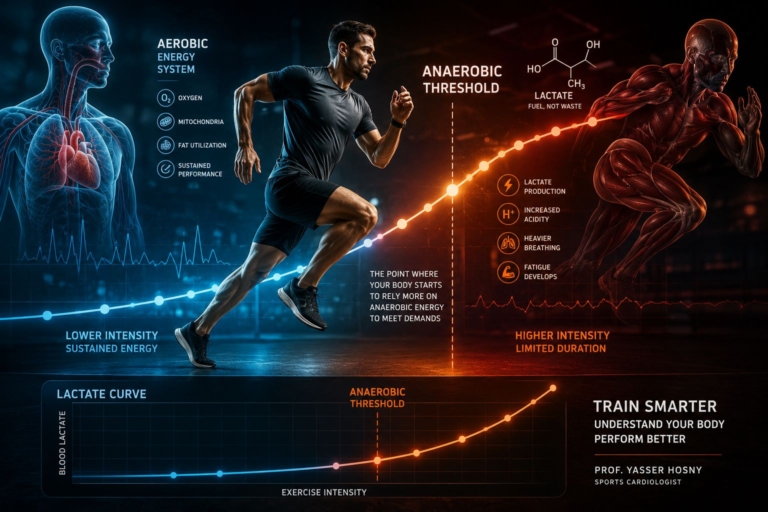
The Anaerobic Threshold represents the point where your body begins changing the way it produces energy to meet increasing exercise demands.
Knowing where this point occurs allows us to prescribe exercise more accurately, improve athletic performance, and, in many cases, help patients exercise more safely.
This is one of the reasons why measuring the Anaerobic Threshold during a Cardiopulmonary Exercise Test (CPET) has become one of the most valuable tools in modern Sports Cardiology.
What Is the Anaerobic Threshold?
Every movement you make requires energy.
Whether you are walking, climbing stairs, running a marathon, or simply playing with your children, your muscles need a constant supply of energy to continue working.
Under normal conditions, your body prefers to produce this energy using oxygen.
This is known as aerobic metabolism, and it is remarkably efficient. It allows you to sustain exercise for long periods while producing minimal fatigue.
As exercise intensity increases, however, your muscles begin demanding energy faster than oxygen alone can supply it.
Rather than forcing you to stop, your body activates an additional pathway capable of producing energy much more rapidly.
This is known as anaerobic metabolism.
The Anaerobic Threshold is the physiological turning point where this contribution becomes increasingly important.
It is not a sudden switch that turns on in a single moment. Instead, it represents a gradual transition where your body begins relying more heavily on anaerobic energy production to keep up with the demands of exercise.
Your Body Was Designed to Protect You, Not to Win Races
One of the misconceptions I often explain to my patients is that the Anaerobic Threshold is not a sign that something is wrong. It is actually one of the body’s most remarkable protective mechanisms.
Think about what happens when you suddenly need to sprint to catch a bus, chase after your child, or compete for the final meters of a race. At that moment, your muscles demand energy faster than your aerobic system can provide it.
Your body has two choices.
It can stop.
Or it can activate a faster backup system.
Fortunately, evolution chose the second option.
The anaerobic energy system allows you to continue exercising by producing energy rapidly, even when oxygen delivery cannot keep pace with demand. This mechanism has helped humans survive for thousands of years, long before modern sport even existed.
Today, it helps athletes push their limits during competition.
However, this extra energy comes at a price.
Why Can’t We Stay Above the Anaerobic Threshold Forever?
his is another question I frequently hear in my clinic.
“Doctor, if my body can produce more energy anaerobically, why can’t I simply stay there throughout the race?”
The answer is surprisingly simple.
Although anaerobic metabolism produces energy quickly, it is far less efficient than aerobic metabolism.
As your body relies more heavily on anaerobic pathways, several physiological changes begin to occur.
Breathing becomes noticeably faster.
Heart rate continues to rise.
The muscles become increasingly acidic as hydrogen ions accumulate.
Your brain begins receiving signals that maintaining the same intensity is becoming more difficult.
Eventually, fatigue forces you to slow down.
This is why the Anaerobic Threshold represents such an important turning point during exercise. Above this point, your body can continue working, but only for a limited period before fatigue becomes overwhelming.
The Biggest Myth I Correct Almost Every Week
If there is one misconception that refuses to disappear, it is this:
“Lactic acid causes muscle soreness.”
I hear this statement almost every week.
It has been repeated by athletes, coaches, gym members, and even healthcare professionals for many years.
The truth is different.
During exercise, your muscles produce lactate, not “lactic acid” as it is commonly described.
More importantly, lactate is not a waste product.
It is an extremely valuable source of energy.
In fact, your heart muscle loves using lactate as fuel. The brain can also use it, and well-trained muscles recycle it efficiently during prolonged exercise.
Even more importantly, lactate disappears from the bloodstream relatively quickly after exercise—usually within about an hour.
So if your muscles hurt the next morning after a hard workout, lactate is no longer there.
The soreness you feel, known as Delayed Onset Muscle Soreness (DOMS), is primarily caused by microscopic damage to muscle fibers and the inflammatory repair process that follows, not by lactate.
Understanding this changes the way we think about exercise physiology.
Lactate is not your enemy.
It is actually one of your body’s most intelligent survival tools.
Does Every Athlete Reach the Anaerobic Threshold at the Same Point?
Absolutely not.
This is one of the reasons I encourage athletes to avoid comparing themselves with others.
Two runners may have exactly the same age.
The same body weight.
The same maximum heart rate.
They may even run side by side during training.
Yet one athlete reaches the Anaerobic Threshold at a much higher running speed than the other.
Why?
Because the Anaerobic Threshold reflects how efficiently the body produces and uses energy.
Athletes with better aerobic conditioning usually develop:
Greater mitochondrial density.
Improved oxygen delivery to working muscles.
Better fat oxidation.
More efficient lactate recycling.
Higher endurance capacity.
As a result, they can maintain higher exercise intensities before relying heavily on anaerobic metabolism.
This is one of the main reasons elite endurance athletes appear to work effortlessly at speeds that leave recreational athletes completely exhausted.
Why Guessing Your Anaerobic Threshold Is a Mistake
In my clinic, I often meet athletes who have downloaded a heart rate zone calculator from the internet or copied a training program from a friend.
While these tools may seem helpful, they cannot tell you where your Anaerobic Threshold actually occurs.
Every individual is different.
Age, fitness level, genetics, medical conditions, medications, and years of training all influence how your body responds to exercise.
This is why I believe exercise prescription should be based on measurement rather than estimation.
The goal is not simply to train harder.
The goal is to train smarter.
And that is exactly where Cardiopulmonary Exercise Testing (CPET) becomes invaluable.
How Do We Measure the Anaerobic Threshold?
One of the questions I receive most frequently is:
“Doctor, how do you actually know where my Anaerobic Threshold is?”
The answer is through a Cardiopulmonary Exercise Test (CPET).
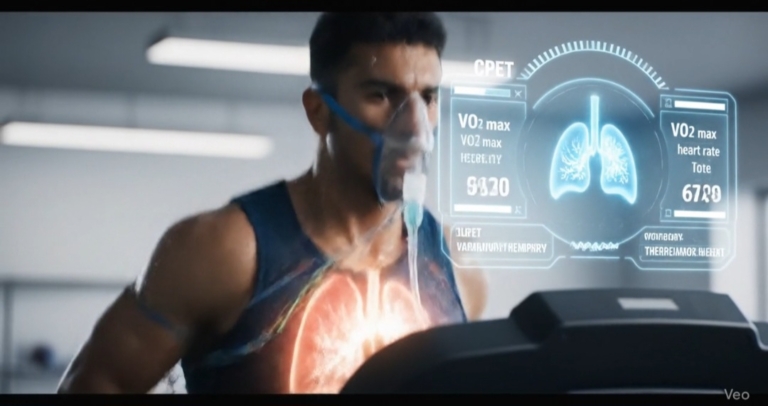
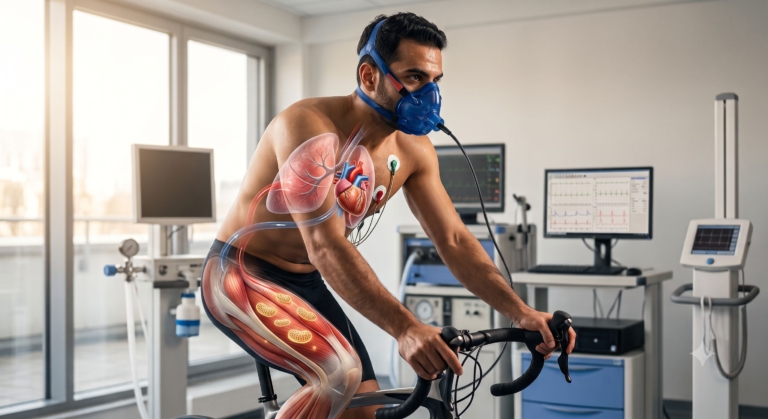
Unlike a traditional exercise stress test, CPET doesn’t only monitor your heart rhythm. It also measures how your heart, lungs, muscles, and metabolism work together while you exercise.
By analyzing the oxygen you consume and the carbon dioxide you produce with every breath, CPET allows us to identify the physiological changes that occur as exercise intensity increases.
Instead of estimating your training zones using age-based formulas or wearable devices, we can determine your thresholds based on your own physiology.
For athletes, this means more precise training.
For patients, it means safer and more individualized exercise prescriptions.
For me, as a Sports Cardiologist, it provides one of the clearest windows into how the body performs under stress.