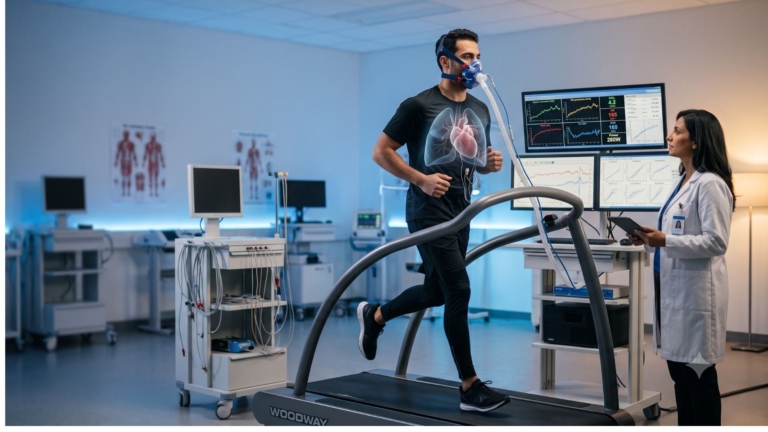

The Hidden Story Behind Every Heartbeat
Two Men. One Finish Line. Two Completely Different Stories.
Ahmed and Omar are both 40 years old.
They live in the same city.
They eat similar food.
Neither of them smokes.
Both decided it was finally time to take care of their health.
Every evening after work, they went for a jog together.
At first, everything seemed the same.
But after only a few minutes, Ahmed was smiling while Omar was struggling to breathe.
They were running at the same speed.
Covering the same distance.
Taking the same number of steps.
Yet inside their bodies, completely different stories were unfolding.
Ahmed’s heart was delivering oxygen efficiently.
His lungs were exchanging gases effortlessly.
His muscles were transforming oxygen into energy like a perfectly tuned power station.
Inside every muscle cell, thousands of tiny structures called mitochondria were producing the energy that kept him moving.
Omar, however, was working much harder.
His heart was beating faster.
His breathing became heavier.
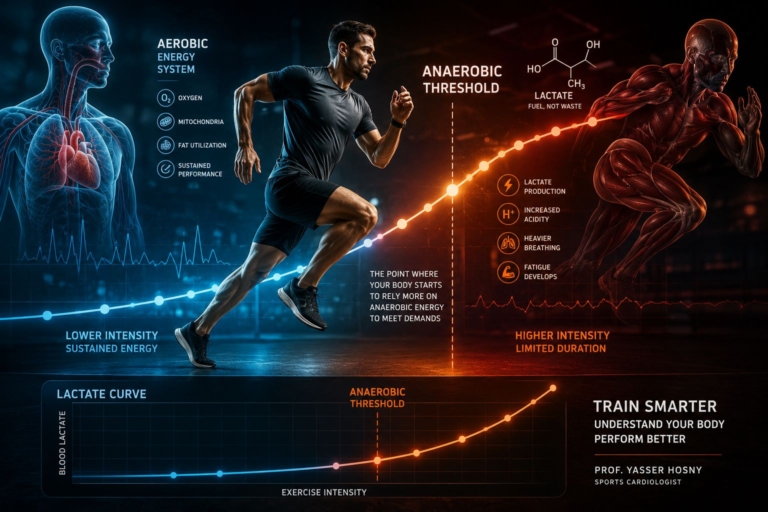
His muscles switched too early from an efficient energy system to a much less efficient one.
He wasn’t lazy.
He wasn’t weak.
His body was simply telling a story that no one could see.
Until one test revealed the truth.
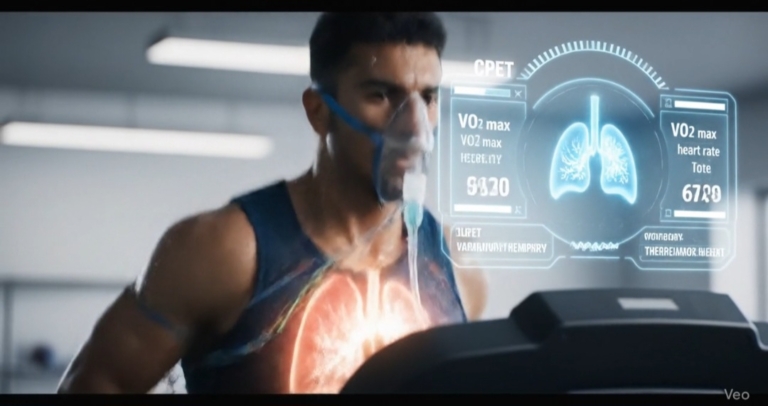
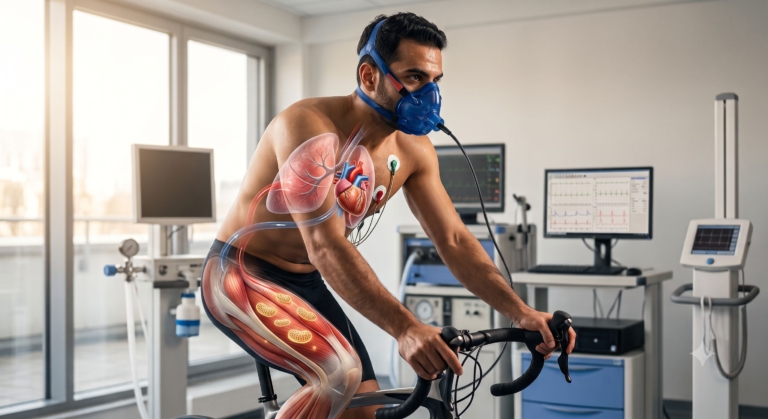
That test was called Cardiopulmonary Exercise Testing (CPET).
Because sometimes…
The most important story about your health is the one your body tells while it is moving.
What Is Cardiopulmonary Exercise Testing (CPET)?
Imagine taking your car to a mechanic because it loses power while driving.
Would the mechanic inspect the engine while the car is parked?
Of course not.
He needs to see it while it is moving.
Your body works exactly the same way.
Many heart, lung and fitness problems only become visible during exercise.
Cardiopulmonary Exercise Testing (CPET) is considered the most comprehensive exercise test available because it evaluates how your heart, lungs, blood circulation, muscles and metabolism work together while you exercise.
Unlike a standard treadmill ECG, CPET does not simply tell us whether your heart is receiving enough blood.
It explains why you become breathless, tired or unable to improve your exercise performance.
Your Body Is Like a Hybrid Car
One of the easiest ways to understand exercise metabolism is to compare your body with a modern hybrid car.
A hybrid car uses two fuel sources:
Electricity
Petrol
Your body also uses two main fuels:
Fat
Carbohydrates
At low exercise intensity, your body mainly burns fat.
As exercise becomes harder, it gradually relies more on carbohydrates because they provide energy more rapidly.
CPET allows us to measure exactly when this transition occurs.
This information helps athletes optimize performance, allows patients to exercise safely and enables physicians to prescribe personalized exercise programs.
The Mitochondria: The Body’s Power Stations
Inside every muscle cell are tiny structures called mitochondria.
Think of them as thousands of microscopic power stations.
They combine oxygen with carbohydrates and fat to produce ATP, the energy that powers every heartbeat, every breath and every movement.
The healthier your mitochondria are, the more energy your body can produce.
Healthy mitochondria improve endurance, physical performance and overall health.
VO₂max: The Horsepower of the Human Body
One of the most important measurements obtained during CPET is VO₂max.
If mitochondria are the body’s power stations, then VO₂max represents the maximum amount of oxygen those power stations can use to produce energy.
A simple way to understand VO₂max is to think of it as the horsepower of the human body.
Just as a powerful engine allows a car to perform better, a higher VO₂max allows your body to produce more energy, exercise longer, recover faster and perform better.
Today, VO₂max is considered one of the strongest indicators of cardiorespiratory fitness and long-term health.
Research has consistently shown that people with higher VO₂max generally live longer, remain independent later in life and have a lower risk of many chronic diseases.
Higher levels of fitness have also been associated with a lower risk of cognitive decline and Alzheimer’s disease.
For these reasons, many scientists now consider VO₂max one of the most valuable measurements of human health.
Why Is CPET Different From a Standard Stress Test?
A conventional treadmill stress ECG mainly evaluates the electrical activity of the heart and helps detect reduced blood flow to the heart muscle.
CPET goes much further.
It simultaneously evaluates:
Heart function
Lung function
Breathing efficiency
Blood circulation
Muscle performance
Metabolism
Oxygen consumption (VO₂)
Carbon dioxide production (VCO₂)
Instead of simply telling us whether exercise is normal or abnormal, CPET explains why exercise capacity is limited.
Who Can Benefit From CPET?
CPET may benefit:
Athletes who want to optimize their performance.
Individuals with unexplained shortness of breath.
Patients with heart disease.
Patients with lung disease.
People beginning an exercise programme.
Individuals wishing to improve their health and longevity.
Anyone interested in understanding how their body performs during exercise.
Key Take-Home Messages
CPET evaluates how the entire body responds to exercise.
Your body functions like a hybrid engine using fat and carbohydrates as fuel.
Mitochondria are the body’s microscopic power stations.
VO₂max is the best available measurement of cardiorespiratory fitness and one of the strongest predictors of long-term health.
Exercise programmes should be based on objective measurements rather than guesswork.
Understanding how your body works allows you to train smarter, perform better and live healthier.